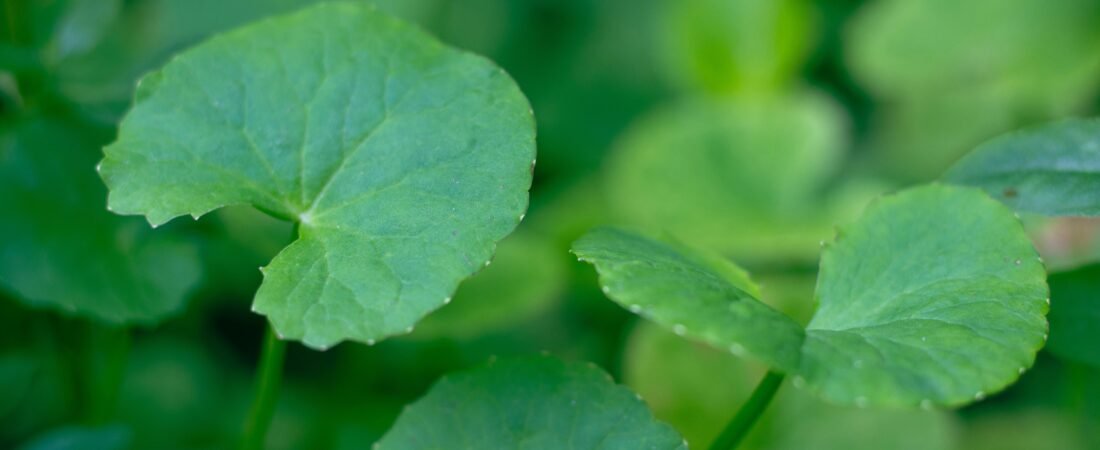
If you’ve browsed more than a handful of Korean skincare products, you’ve probably noticed one ingredient showing up again and again — in toners, ampoules, creams, even sheet masks. Sometimes it’s listed as Centella Asiatica. Sometimes it’s cica. Sometimes it’s tiger grass, or gotu kola.
It’s all the same plant, and it’s not a passing trend. Centella has been used in traditional medicine for centuries, and modern skincare research has spent the last few decades catching up to why.
What Centella Asiatica (Cica) Actually Is
Centella Asiatica is a small, leafy plant that grows in damp, swampy ground across tropical and subtropical Asia. In skincare it’s used as an extract, valued for a group of compounds called triterpenoids — mainly asiaticoside and madecassoside, along with their related acids, asiatic acid and madecassic acid. These are the components most of the research on Centella actually focuses on.
The different names are less confusing than they look. “Cica” is the shorthand K-beauty brands adopted, and “tiger grass” is a marketing name. “Gotu kola” and “Indian pennywort” are older common names carried over from traditional use. On an ingredient list, what you’re looking for is Centella Asiatica Extract, Centella Asiatica Leaf Extract, or Centella Asiatica Leaf Water — or the individual triterpenoids listed by name.
One thing worth knowing: “contains Centella” and “contains a meaningful amount of Centella” aren’t the same claim. If the extract sits near the end of a long ingredient list, it’s likely there in small amounts.
What Centella Does for Sensitive, Reactive Skin
Centella’s biggest reputation is as a soothing ingredient, and that reputation is reasonably well-supported. It’s commonly included in formulas aimed at redness, irritation, and reactive skin — the kind of skin that responds badly to new products, weather changes, or over-exfoliation.
Part of this appears to come down to Centella’s antioxidant activity. In lab studies, its triterpenoids help neutralize reactive oxygen species and support the skin’s own antioxidant defenses, which matters because oxidative stress tends to show up alongside inflammation. Centella is also widely studied for wound healing and barrier support, and that may be part of why it seems to help with redness in the first place — a compromised barrier is often what’s driving the irritation.
Honest note: Most of the strongest evidence comes from lab and wound-healing research rather than large trials of cosmetic creams, so it’s fair to treat “soothing” as a reasonable expectation rather than a guarantee. Centella also isn’t a treatment for chronic skin conditions like rosacea or eczema, and it won’t replace a dermatologist’s guidance if you’re dealing with persistent redness. What it seems to do well is support skin that’s mildly reactive or recovering — after exfoliation, after sun exposure, or just on days your skin feels more sensitive than usual.
Why Korean Skincare Leans on Centella So Heavily
Korean skincare culture is built around the idea that a strong skin barrier is the foundation everything else depends on — you can read more about that logic in our 7-step Korean skincare routine guide. Centella fits that philosophy almost perfectly. It’s gentle enough for daily use for most people, it isn’t known to conflict with other common actives, and it’s often paired with heavier-hitting ingredients like niacinamide or exfoliating acids to offset the irritation those can cause.
That’s also why you’ll see Centella positioned at nearly every step of a routine rather than confined to one product category. A Centella toner preps the skin. A Centella serum or ampoule delivers it in a more concentrated step. A Centella cream can combine it with the moisturizing layer you leave on overnight. It’s less a single hero product and more a supporting ingredient that shows up throughout.
Who Actually Benefits From Centella Asiatica
- Sensitive or reactive skin — this is where Centella earns its reputation most clearly
- Post-exfoliation or post-active routines — commonly used to calm skin after AHAs, BHAs, or retinoids
- Redness-prone skin — including occasional flushing, not just chronic conditions
- Anyone building a minimal, barrier-first routine — it layers easily and is well tolerated by most people
If your skin is neither sensitive nor reactive, Centella is unlikely to cause problems, but it’s also not going to be the ingredient doing the heavy lifting in your routine. It’s more of a quiet, supportive presence than a targeted treatment.
How to Use Centella in Your Routine
Centella layers well with almost everything, which makes it easy to add wherever you’re already seeing irritation. A few common entry points:
- A Centella toner, right after cleansing, especially on days your skin feels reactive
- A Centella serum or ampoule layered before moisturizer, for more concentrated calming
- A Centella cream as your final step, if redness is a persistent concern rather than an occasional one
You don’t need all three. Pick the step you’re most likely to stay consistent with.
The Realistic Version
Worth adding if your skin is reactive, flushes easily, or is recovering from actives. One Centella product is usually enough — most people find a serum or a cream the easiest place to start.
Optional: layering Centella at several steps. It’s pleasant and there’s no real downside, but it’s refinement rather than a foundational change.
Not a priority if your skin is comfortable and the basics aren’t in place yet. A gentle cleanser, a moisturizer, and daily sunscreen will do more for your barrier than any single soothing ingredient.
A Note on Patch Testing
Centella is generally well tolerated, but reactions can still happen. Allergic contact reactions have been reported, so it makes sense to patch test any new Centella product on a small area — behind the ear or along the jawline — before applying it to your whole face.
If your skin is actively broken, raw, or severely irritated, be more cautious with any new skincare product and keep the routine simple until the skin settles.
If a product stings or leaves lasting redness, treat that as information rather than something to push through.
Where to Go From Here
Centella is one piece of a much bigger picture. If you’re curious about how it fits alongside other key ingredients, a few natural next reads:
- Ceramides vs. Niacinamide — what your skin barrier actually needs, and when to reach for each
- The 7-Step Korean Skincare Routine — where Centella typically shows up in a full routine
- Building a routine for sensitive skin — how to structure a minimal, barrier-first approach
Centella isn’t a miracle ingredient, and no single product will repair a compromised barrier overnight. But as a consistent, generally low-risk addition to a routine, it’s one of the more broadly useful ingredients Korean skincare has to offer.